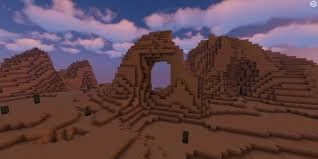
The Mounts of Mayhem update transformed Minecraft’s desert from a relatively harmless expanse into the Overworld’s deadliest biome. Thanks to newly-introduced camel husks, parched skeletons, and resource scarcity, venturing into sandy terrain now requires serious preparation—or you’ll quickly discover why experienced players approach deserts with genuine caution.
Table of Contents
What Makes Desert Minecraft Biomes Deadly Now
| Threat Category | Specific Danger | Impact Level | Counter Strategy |
|---|---|---|---|
| Camel Husks | Fast zombies immune to sunlight | Extreme | Diamond armor + enchanted weapons |
| Parched Skeletons | Shoot weakness arrows | High | Shields + distance combat |
| No Wood Sources | Zero trees for tools/shelter | Critical | Bring wood or find structures |
| No Food Supply | Only rabbits spawn (hard to catch) | High | Pack golden carrots beforehand |
| Nighttime Mob Spawns | Open terrain = endless hostiles | Medium-High | Build temporary shelters |
The Camel Husk Nightmare
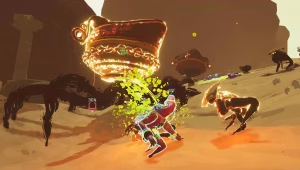
Unlike standard zombies that burn in sunlight and shuffle slowly, camel husks patrol deserts relentlessly—day and night. These mounted nightmares spawn with significantly higher frequency than typical desert mobs, creating constant combat scenarios that drain resources quickly.
Their speed makes outrunning them nearly impossible on foot. Their extended reach allows them to hit you before you close distance for melee attacks. When paired with parched skeleton riders shooting weakness arrows, camel husks become mini-bosses requiring mixed combat approaches rather than simple sword-spamming.
According to survival game design principles, environmental scarcity combined with aggressive enemies creates compounding difficulty—Minecraft’s desert now exemplifies this perfectly.
For comprehensive combat strategies against new hostile mobs, check our Minecraft Mounts of Mayhem guide.
Resource Scarcity Creates Cascading Problems
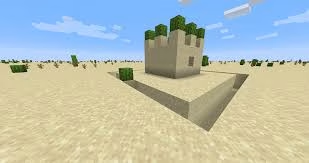
Deserts offer virtually nothing for basic survival. No trees mean no wood for crafting tables, tools, or weapons. No passive animals (except elusive rabbits) mean no sustainable food sources. No shelter materials force you to dig underground or locate rare structures like villages or pillager outposts.
This scarcity wouldn’t matter much in peaceful biomes where you can travel safely to better terrain. But when camel husks chase you relentlessly and nighttime spawns surround you, the lack of basic resources transforms minor inconveniences into life-threatening emergencies.
Critical survival mistake: Spawning in or entering a desert unprepared. Always bring:
- At least one stack of wood logs
- Full stack of cooked food (golden carrots ideal)
- Complete armor set (minimum iron, diamond preferred)
- Enchanted weapons with Sharpness/Smite
- Blocks for emergency pillar escapes
Nighttime Becomes a Mob Farm
The desert’s flat, obstacle-free terrain creates perfect conditions for mass mob spawning after sunset. With no natural barriers, trees, or terrain features to block line-of-sight, hostile mobs spot you from enormous distances and converge rapidly.
Combine this with camel husks (already present during daylight) and you face overwhelming numbers. The usual strategy of “run to safety” fails when there’s literally nowhere to hide across endless sand dunes.
Smart players dig three-block-deep holes and seal themselves underground until dawn—treating desert nights like mini-Nether excursions requiring extreme caution.
Why Previous Desert Strategies Failed
Before Mounts of Mayhem, deserts posed minimal threats. Regular husks moved slowly and burned eventually if you lasted until dawn. Skeletons could be easily avoided or killed from distance. The biggest danger was accidentally walking into cacti.
Old survival wisdom—”just avoid deserts early-game”—no longer works when world generation spawns villages, temples, and valuable archaeology sites exclusively in sandy biomes. Players must now engage with deserts rather than bypass them entirely.
Visit our Minecraft biome survival guide for strategies across all terrain types.
Structural Advantages (If You Find Them)
Desert villages, pillager outposts, and desert pyramids provide crucial refuge when located. Villages offer beds for respawn points, crafting stations, food from farm plots, and tradeable villagers. Pyramids contain valuable loot chests worth the TNT trap risk.
The problem? These structures spawn randomly and irregularly. You might trek across massive desert expanses without encountering a single safe location. When camel husks chase you across barren terrain with no structures visible, your survival depends entirely on pre-brought supplies.
Archaeological Sites Add Risk-Reward Tension
The archaeology update added suspicious sand blocks containing pottery shards and ancient items throughout deserts. Excavating these treasures requires staying stationary while brushing—leaving you vulnerable to approaching camel husks.
This creates genuine tension: do you risk excavating for rare rewards while exposed, or do you play safe and miss valuable historical artifacts? The desert forces constant risk-assessment calculations absent from safer biomes.
Comparison to Other “Dangerous” Biomes
Deep Dark: More lethal but avoidable (underground, optional content)
Swamp: Witches dangerous but spawn rarely, terrain navigable
Ocean: Drowning risk manageable with doors/potions, Guardians localized
Desert: Unavoidable (overworld spawn), constant threat, zero resources
The desert’s unique danger stems from combining resource scarcity with aggressive mobs across mandatory terrain. You can’t avoid deserts like you avoid Deep Dark. You can’t prepare underwater breathing for deserts like you do oceans. You either bring everything or die.
Developer Intent Behind the Changes
Mojang clearly wanted to increase desert challenge after years of player complaints about “boring” sandy biomes. The Mounts of Mayhem update succeeded—perhaps too well. What was once peaceful exploration became tense survival gauntlet testing preparation and combat skill simultaneously.
This difficulty spike matches Minecraft’s evolution toward harder endgame content. Players seeking genuine survival challenges now have compelling overworld options beyond hunting the Ender Dragon or raiding Woodland Mansions.
When to Tackle Deserts Safely
Early Game (First 3 Days): AVOID unless spawned directly in one. Focus on establishing bases in forests/plains first.
Mid Game (Iron Gear): Brief expeditions acceptable if well-supplied. Locate villages for future use but don’t linger.
Late Game (Diamond+/Netherite): Full exploration viable. Enchanted gear makes camel husks manageable rather than overwhelming.
Endgame (Full Enchantments): Desert archaeology and temple raiding become enjoyable rather than terrifying. Proper preparation eliminates most threats.
FAQs
Why are camel husks so much more dangerous than regular husks in Minecraft?
Camel husks move significantly faster than players on foot, don’t burn in sunlight, often carry parched skeleton riders, and spawn at much higher frequencies—creating constant combat pressure unlike slow regular zombies.
What’s the minimum gear needed to safely explore desert biomes after Mounts of Mayhem?
Full iron armor minimum (diamond strongly recommended), enchanted sword with Sharpness III+, shield, bow with Power enchantment, one stack of wood, full stack of cooked food, and building blocks for emergency shelters.