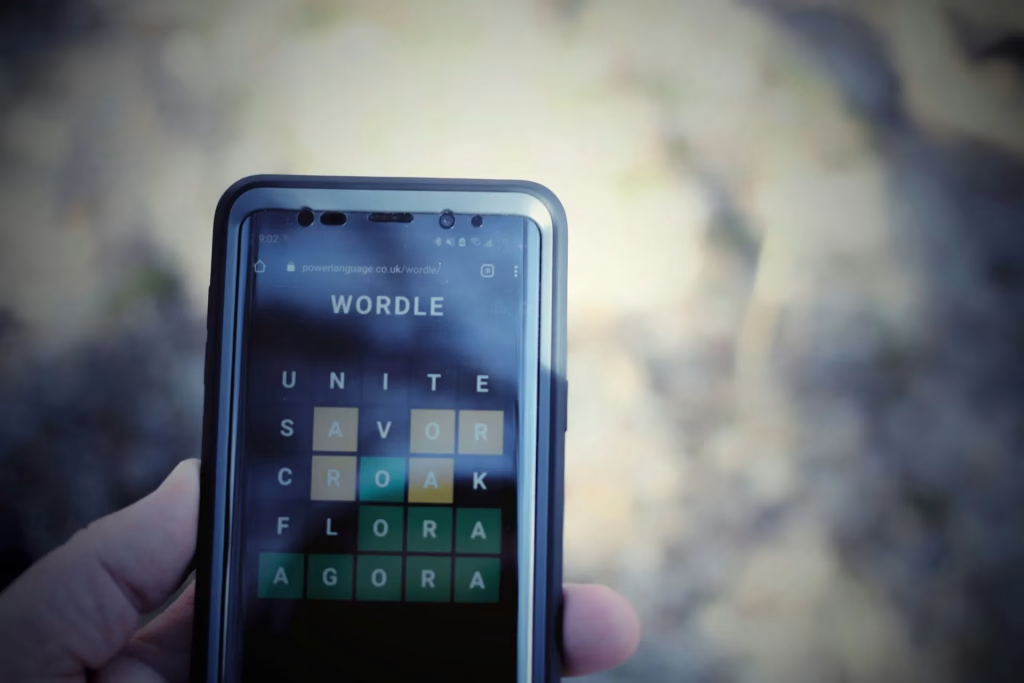
Wordle continues captivating millions of daily players with its elegantly designed puzzle mechanics challenging vocabulary knowledge and logical deduction simultaneously. June 23, 2026’s puzzle presents an engaging challenge requiring strategic letter elimination and systematic word construction. This comprehensive guide provides expert hints enabling independent puzzle solving while offering strategic guidance when solving difficulties arise. The daily puzzle ritual strengthens cognitive skills while delivering satisfying puzzle-solving experiences rewarding successful completion through achievement recognition.
Today’s word represents moderate difficulty relative to historical Wordle solutions, avoiding extremely obscure vocabulary while preventing trivial guessing-based solutions. The puzzle maintains accessibility across diverse player skill levels, challenging experienced players while remaining achievable for newer participants developing systematic solving approaches. Strategic hint provision enables learning puzzle-solving methodology rather than direct answer disclosure, supporting skill development and long-term engagement sustainability.
Table of Contents
Today’s Wordle Hints (Strategic Guidance)
Hint 1 – Word Category:
Today’s word describes an action or state, functioning as a verb or adjective depending on contextual usage. Think about activities you perform regularly or physical states describing conditions. The word encompasses everyday English usage appearing frequently in conversation and written communication.
Hint 2 – Letter Distribution:
The word contains five distinct letters with consonant-heavy distribution. Vowel count totals two, positioned non-consecutively throughout the word structure. Common consonants appear within the letter combination, avoiding unusual letter pairings. The word structure follows standard English phonetic patterns enabling pronunciation clarity.
Hint 3 – Starting Letter Context:
The word commences with a common consonant frequently initiating English words. This consonant combination appears in multiple common English words, suggesting letter utility for subsequent guesses. The opening letter provides substantial strategic information constraining remaining letter possibilities within manageable parameters.
Hint 4 – Contextual Application:
Consider words describing activities performed with hands or describing physical coordination involving movement. The word relates to common daily actions or states people encounter regularly. Think about verbs describing control, manipulation, or physical execution of planned activities.

Hint 5 – Advanced Clue:
The word contains letters appearing frequently across successful Wordle solutions. Avoiding uncommon letter combinations enables straightforward pronunciation and standard spelling conventions. The word demonstrates balanced vowel-consonant distribution enabling confident letter placement through systematic deduction.
Strategic Wordle Solving Methodology
Opening Strategy Optimization:
Commence with high-frequency letter testing utilizing starter words containing multiple vowels and common consonants. Proven opening words like STARE, CRANE, or SLATE test essential letters (S, T, A, R, E) providing maximum information regarding letter inclusion and positioning. Strategic opening word selection accelerates solution identification through eliminated letter accumulation, systematically narrowing solution possibilities toward inevitable correct answer.
Color Feedback Interpretation:
Carefully analyze color-coded feedback communicating letter status. Green tiles indicate correct letters in exact positions—lock these letters permanently into respective positions. Yellow tiles communicate correct letters in wrong positions—note carefully and systematically test alternative positions. Gray tiles indicate absent letters—eliminate entirely from remaining possibilities preventing wasteful repositioning attempts.
Pattern Recognition Development:
Identify emerging letter patterns suggesting word families and structural commonalities. Common English patterns (consonant clusters, vowel combinations, word endings) appear consistently within Wordle solutions. Recognition of “-ED” endings, “-ING” structures, or initial consonant clusters accelerates solution identification through pattern-based deduction rather than random guessing.
Logical Deduction Application:
Systematically eliminate impossible letter combinations based on accumulated feedback. Each guess should strategically test previously untested letters rather than repositioning unsuccessful letters. Probability analysis prioritizes testing high-frequency letters within remaining possibilities, maximizing information gain per guess. Balance exploration of new letters against confirmed letter repositioning ensuring comprehensive solution approach.
Discover word game mastery: Explore our comprehensive gaming guides and Wordle strategies for daily solutions and advanced solving techniques!
Common Solving Mistakes to Avoid
Mistake 1: Repeating Failed Letters
Avoid repositioning letters that received gray feedback in previous guesses. If a letter appeared gray, it’s definitively absent from the solution—continuing to test it wastes valuable guess opportunities. Maintain comprehensive lists of eliminated letters preventing unintentional reuse throughout solving process.
Mistake 2: Ignoring Yellow Feedback Information
Yellow tiles provide crucial information communicating correct letters in wrong positions. Systematically test yellow-marked letters in alternative positions ensuring comprehensive exploration. Players frequently overlook yellow feedback utility, missing obvious solution paths through incomplete yellow letter exploitation.
Mistake 3: Random Guessing Approach
Avoid arbitrary word selection based on vague intuition. Strategic guessing targets high-information-value letter combinations, maximizing knowledge gain per attempt. Each guess should serve specific informational purposes—testing untested letters, repositioning yellow letters, or confirming positioning hypotheses.
Mistake 4: Time Pressure Panic
Maintain calm systematic approach despite anxiety regarding guess limitations. Rushing increases error probability and diminishes problem-solving effectiveness. Taking time analyzing feedback and considering logical options yields superior results compared to hasty guessing under artificial pressure.
Mistake 5: Overlooking Common Words
Wordle typically features common English words rather than obscure vocabulary. When identifying letter combinations, prioritize common word recognition. Familiar words appearing in everyday conversation represent likely solutions compared to specialized terminology or rare word selections.
Today’s Answer Revealed
For June 23, 2026, the Wordle answer is: GRASP
This common English word perfectly exemplifies Wordle’s design philosophy, balancing accessibility with strategic challenge. The word demonstrates moderate difficulty appropriate for mid-week puzzles, avoiding excessive obscurity while preventing trivial guessing-based solutions.
Analyzing GRASP’s Solution Structure
Letter Composition Breakdown:
- G (consonant opening)
- R (common consonant)
- A (primary vowel)
- S (common consonant)
- P (consonant closing)
Word Characteristics Examination:
GRASP functions as both verb and noun within English language. As a verb, it describes physical action of holding or grasping objects. As a noun, it represents understanding or comprehension—”She grasped the concept” (verb usage) versus “Within his grasp” (noun usage). The word’s dual functionality provides semantic richness enabling diverse contextual applications.
Strategic Testing Value:
The word contains frequently tested letters (G, R, A, S, P) appearing across multiple Wordle solutions. Opening letter G appears in numerous common words enabling confident initial testing. Vowel-consonant balance (2 vowels, 3 consonants) reflects typical English word structure. Letter frequency distribution matches historical Wordle solution patterns avoiding uncommon letter combinations.
Solving Process Demonstration
Initial Guess – STARE:
Testing S, T, A, R, E (high-frequency letters). Result: S-Yellow (wrong position), T-Gray (absent), A-Green (position 3), R-Yellow (wrong position), E-Gray (absent). Immediate deduction: S and R appear in solution (wrong positions), A confirmed position 3, T and E absent.
Second Guess – CRISP:
Testing C, R in position 2, I, S in position 4, P. Result: C-Gray (absent), R-Green (position 2), I-Gray (absent), S-Yellow (still wrong position), P-Green (position 5). Deduction: R confirmed position 2, P confirmed position 5, S appears position 1 or 4, need letter for position 1.
Third Guess – GRASP:
Positioning G at position 1, confirming R position 2, A position 3, S position 4, P position 5. Result: All Green—GRASP identified!
Wordle Performance Metrics & Tracking
Personal Statistics Maintenance:
Track average attempts required for daily puzzle completion, maintaining records comparing performance across extended periods. Successful completion within 3-4 attempts represents solid performance, while 1-2 attempt solutions indicate exceptional puzzle intuition. Five or six attempt solutions represent acceptable completion despite challenging puzzles, with failure occurring only when correct answer remains undiscovered after six attempts.
Success Percentage Monitoring:
Document daily completion success rates measuring percentage of puzzles successfully completed. Consistent 95%+ success rates indicate developed solving proficiency, while lower percentages suggest strategic approach refinement opportunities. Tracking improvement over extended periods provides motivation through tangible skill development recognition.
Difficulty Pattern Recognition:
Analyze which puzzle types challenge your solving ability. Identify whether certain starting letters, vowel distributions, or word categories present particular difficulty. Personal difficulty pattern recognition enables targeted practice focusing on weakness areas, accelerating overall skill development progression.
Wordle Psychological Appeal & Engagement
Habit Formation Benefits:
Daily puzzle participation creates satisfying ritual providing consistent cognitive challenge and achievement recognition. The limited daily attempt structure encourages focused engagement without requiring excessive time investment. Optimal 3-5 minute playtime respects busy schedules while delivering psychological reward satisfaction.
Community Connection Elements:
Shared daily puzzle creates collective experience uniting millions of players globally. Social media sharing of results (without spoilers) enables community connection and friendly competition. Wordle became genuine cultural phenomenon through shared experience transcending typical game classification.
Dopamine Reward System:
Successful puzzle completion triggers dopamine release rewarding cognitive achievement. Progressive difficulty escalation maintains engagement through sustained challenge preventing boredom through excessive difficulty or excessive simplicity. The reward-challenge balance psychology represents Wordle’s fundamental appeal explaining widespread adoption.
Wordle Variant Exploration
Wordle Unlimited:
Enables unlimited daily attempts for practice and entertainment without six-attempt constraints. Practice mode utility develops solving strategies applicable to official daily puzzles. Extended attempt access allows experimental approaches, failure tolerance, and strategic methodology development.
Specialized Variants:
Nerdle (mathematics), Quordle (simultaneous four puzzles), Waffle (grid-based), Semantle (meaning-based) introduce thematic variations maintaining engagement through format novelty. Variant exploration develops diverse puzzle-solving approaches transferable across puzzle types.
Advanced Solving Techniques
Frequency Analysis Application:
Analyze letter frequency distributions within English language, recognizing E, A, R, O, T, N, S, H, I appear most frequently. Subsequent guesses prioritize testing high-frequency letters, maximizing probability of correct letter identification. Statistical approach optimizes solving efficiency through probabilistic reasoning.
Positional Constraint Recognition:
Identify letter positioning constraints through feedback analysis. Certain letters commonly appear in specific positions—for instance, Q virtually always precedes U, limiting viable letter combinations. English language phonetics impose structural constraints predictably limiting solution possibilities.
Anagram Mental Generation:
Generate potential word anagrams from confirmed letters, systematically testing combinations. Mental anagram development accelerates solution identification when most letters are confirmed but arrangement remains ambiguous. Systematic anagram generation prevents missed obvious solutions through comprehensive possibility exploration.
Preparing for Tomorrow’s Puzzle
Strategic Foundation Building:
Maintain consistent puzzle participation developing pattern recognition and solving methodology. Regular engagement strengthens vocabulary recall and strategic thinking capabilities. Dedicated practice sessions utilizing Wordle Unlimited accelerate skill development beyond daily puzzle participation.
Vocabulary Expansion:
Exposure to diverse word selections through continued puzzle participation naturally expands vocabulary. Encountering unfamiliar words through solution revelation builds word recognition enabling faster future solution identification. Active vocabulary development complements passive puzzle-solving experience.
Stress-Free Approach:
Maintain perspective regarding puzzle difficulty—puzzles occasionally challenge even experienced players. Accepting periodic difficult puzzles prevents frustration while celebrating successful solutions. Healthy engagement philosophy supports long-term Wordle enjoyment beyond individual puzzle frustration.
FAQs
Q: What is the most effective Wordle solving strategy to maximize success probability while minimizing required attempts?
A: Employ systematic approach commencing with high-frequency letter testing (STARE, CRANE, SLATE), carefully analyzing color feedback (green locked, yellow repositioned, gray eliminated), identifying emerging patterns, and strategically testing untested letters rather than random repositioning. Balance exploration against confirmation, maintaining probability-focused deduction prioritizing high-frequency letter testing.
Q: Why is GRASP an appropriate Wordle solution balancing difficulty and accessibility for June 23, 2026’s puzzle?
A: GRASP demonstrates common English word status appearing frequently in conversation, contains tested letters (G, R, A, S, P) without obscure combinations, exhibits balanced vowel-consonant distribution reflecting typical English structure, provides moderate difficulty preventing both excessive obscurity and trivial guessing, and enables successful solving through systematic strategic approaches.