Taxi missions might seem like the quietest corner of the Grand Theft Auto universe, but they’ve been cruising through the franchise since GTA 3. These side hustles let you play cabbie across iconic cities, earning cash while exploring virtual streets. But which game delivered the best taxi experience? Let’s rank every iteration from mundane to magnificent.
Table of Contents
The Complete GTA Taxi Mission Rankings
| Rank | Game | What Made It Special | Standout Feature |
|---|---|---|---|
| 🥇 1st | GTA San Andreas | Diverse map diversity | Three cities plus deserts and forests |
| 🥈 2nd | GTA Vice City | Fast-paced excitement | Quick taxis on tight 1980s streets |
| 🥉 3rd | GTA 4 | Story integration | Connected to Roman’s business |
| 4th | GTA Online | Modern implementation | Freemode flexibility |
| 5th | GTA 3 | Original pioneer | Introduced the concept |
Why San Andreas Takes the Crown
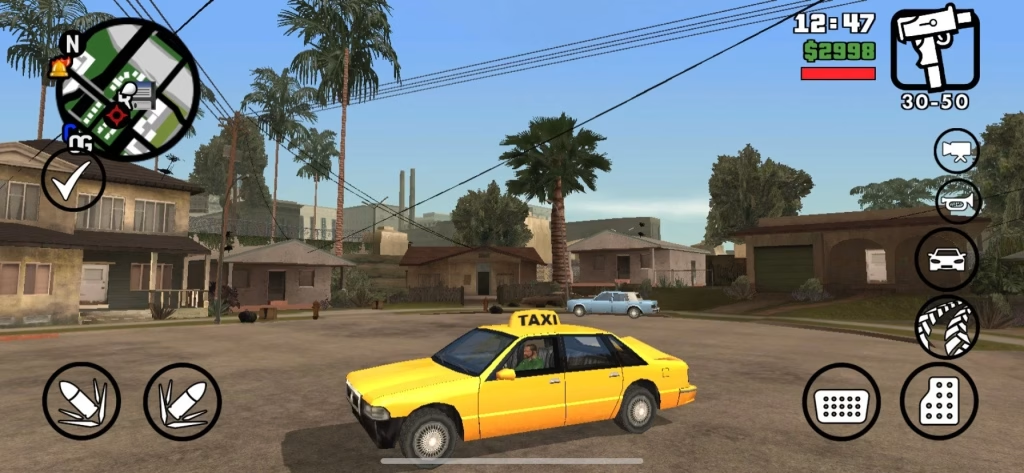
GTA San Andreas transforms simple taxi work into epic cross-state journeys. Picture this—you pick up a passenger in Los Santos, cruise through scorching deserts, navigate dense forests, and drop them off in San Fierro. The sheer geographic variety keeps every fare feeling fresh. Short city hops through traffic offer intense time pressure, while rural routes let you appreciate the game’s massive scope.
The mission mechanics remained faithful to earlier games, but the expanded map made all the difference. You weren’t just driving blocks—you were experiencing California’s diverse landscapes compressed into gaming perfection. Discover more about GTA’s evolution through the years.
Vice City’s Neon-Soaked Second Place
Vice City’s taxi missions captured the franchise’s most stylish era. The 1980s setting meant cruising neon-lit streets in period-accurate cabs that handled surprisingly well. The compact map design ensured constant action without tedious long hauls. Every pickup felt urgent, every drop-off rewarding.
What Vice City lacked in variety, it compensated with pure vibes. The radio stations blasting synth-pop while you navigated Ocean Drive created unforgettable moments that transcended simple side mission grinding.
GTA 4’s Narrative Integration
Liberty City brought realism and storytelling to taxi work. Since protagonist Niko’s cousin Roman operated a taxi depot, these missions felt narratively justified rather than random. The physics-based driving made navigating dense traffic genuinely challenging—every turn required actual skill.
However, the heavier vehicle handling and serious tone made taxi missions less immediately fun than Vice City’s arcade simplicity. Still, the connection to Roman’s business added emotional weight missing from other entries.
Why GTA 3 and Online Rank Lower
GTA 3 deserves respect for originating the concept, but limited technology constrained the experience. Basic mechanics and a smaller map meant repetition set in quickly. Meanwhile, GTA Online’s taxi work suffers from being overshadowed by heists, businesses, and flashier content. Using stock taxis in a world of flying motorcycles feels underwhelming, though the missions function perfectly fine mechanically.
The Taxi Mission Formula Explained
| Element | Purpose | Evolution Across Games |
|---|---|---|
| Pick up passengers | Initiate mission | Remained consistent |
| Time limit pressure | Create urgency | Got stricter in later games |
| Destination markers | Guide navigation | Improved with better GPS |
| Payout system | Reward completion | Scaled with game economies |
| Vehicle damage | Add difficulty | More punishing in GTA 4 |
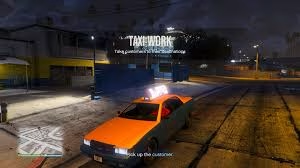
Every GTA since 3 has kept the core loop intact: find a taxi, activate the mission via taxi light, pick up passengers, deliver them safely within time limits. The magic lies in how each game’s unique setting and mechanics transform this simple structure.
FAQs
Do taxi missions affect game completion percentage?
No, taxi missions are optional side activities that don’t impact story completion, though they often unlock useful rewards like infinite sprint or health boosts.
Which GTA game pays best for taxi work?
GTA Online offers the highest nominal payouts at several thousand dollars per fare, though adjusted for each game’s economy, they’re roughly equivalent value.