Gotta solve ’em all! The PokéDoku puzzle for August 20, 2026, is live — and today’s grid is a tricky mix of type knowledge, regional memory, and cross-referencing that’ll test even the most dedicated Pokémon Professors.
PokéDoku is a daily Pokémon puzzle game that combines Sudoku-like logic with Pokédex knowledge. Each day, players must fill a 3×3 grid where every cell requires a Pokémon that satisfies two conditions simultaneously — the column type/category and the row type/category.
Don’t scroll to the answers until you’ve tried the hints first — that’s where the real fun is. Ready? Let’s solve today’s PokéDoku! 🎯⚡
Table of Contents
How PokéDoku Works — Quick Refresher
| Detail | Info |
|---|---|
| Game | PokéDoku |
| Type | Daily Pokémon puzzle |
| Grid | 3×3 (9 cells total) |
| Objective | Place a Pokémon in each cell that satisfies BOTH the row and column conditions |
| Conditions | Types, generations, evolution stages, legendary status, etc. |
| Guesses | 9 total — one per cell |
| Rarity Score | Lower = more unique answer (fewer players chose the same Pokémon) |
| Resets | New puzzle every day at midnight |
| Platform | pokedoku.com (free, browser-based) |
The key to PokéDoku isn’t just knowing which Pokémon fit — it’s finding the RAREST valid answer for each cell. Common picks like Charizard and Pikachu score poorly because everyone chooses them. The real challenge is finding obscure Pokémon that satisfy both conditions while keeping your rarity score as low as possible.
Today’s Grid — August 20, 2026
⚠️ Hints first, answers below! Try to solve it yourself before scrolling to the solutions.
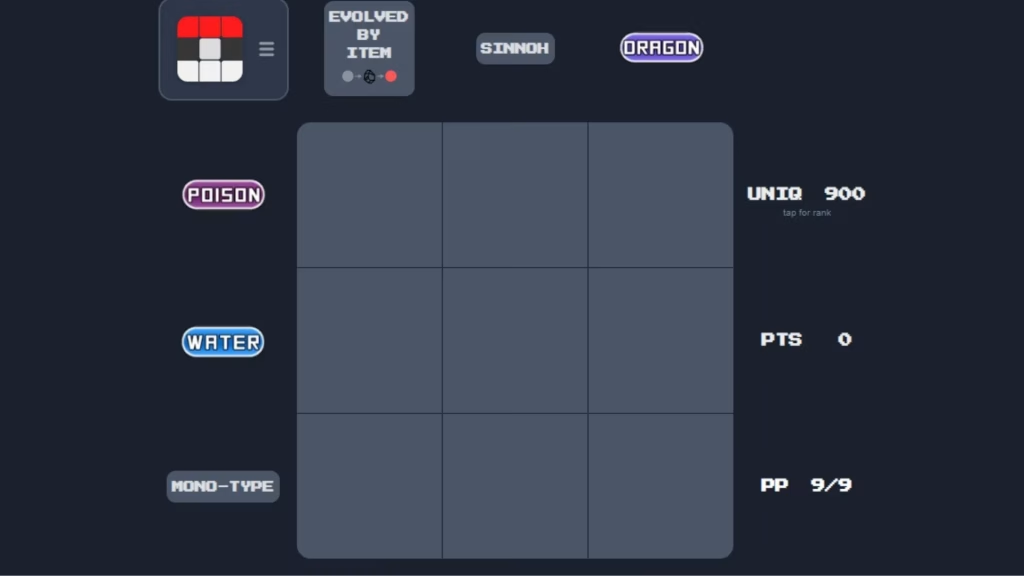
Today’s PokéDoku features a mix of type-based and category-based conditions across its rows and columns. The grid tests knowledge of dual typings, regional variants, and generational knowledge.
Spoiler-Free Hints — Cell by Cell
Use these hints to guide your solving without seeing the answers:
| Cell | Hint | Difficulty |
|---|---|---|
| Top-Left | Think about a Pokémon that’s been around since Gen 1 — a classic dual-type | 🟢 Easy |
| Top-Center | This cell rewards deep knowledge of Gen 3 or Gen 4 Pokémon | 🟡 Medium |
| Top-Right | Consider a Pokémon with an unusual type combination rarely seen in the games | 🔴 Hard |
| Middle-Left | A well-known evolution chain has a member that fits perfectly | 🟢 Easy |
| Middle-Center | This is the trickiest cell today — cross-reference carefully | 🔴 Hard |
| Middle-Right | Think about regional forms or alternate forms introduced in recent generations | 🟡 Medium |
| Bottom-Left | A starter Pokémon or its evolution might work here | 🟢 Easy |
| Bottom-Center | Consider Pokémon from the Unova or Kalos regions | 🟡 Medium |
| Bottom-Right | The rarest cell — few Pokémon satisfy both conditions | 🔴 Hard |
Strategy Tips Before Checking Answers
The Rarity Score System
PokéDoku assigns a rarity percentage to each answer based on how many other players chose the same Pokémon. Your goal is to minimize your total rarity score across all 9 cells.
| Score | Meaning | Strategy |
|---|---|---|
| 90%+ | Almost everyone picked this Pokémon | ❌ Too obvious — try harder |
| 50–89% | Common pick — most players know it | 🟡 Acceptable but not impressive |
| 10–49% | Uncommon pick — good knowledge | 🟢 Solid rarity score |
| 1–9% | Rare pick — deep Pokédex knowledge | 🏆 Excellent |
| <1% | Ultra-rare — virtually unique answer | 👑 PokéDoku master |
Rarity Score Tips
| Tip | Why It Works |
|---|---|
| Avoid Gen 1 picks when possible | Everyone defaults to Kanto — scores are always high |
| Use regional forms | Alolan, Galarian, Hisuian forms are valid but rarely chosen |
| Think about NFE Pokémon | Not Fully Evolved Pokémon are often overlooked |
| Consider PLA or SV exclusives | Newer Pokémon have lower pick rates |
| Dual-type picks are key | Single-type Pokémon can only satisfy one condition — dual-types cover both |
| Save the hardest cell for last | If a cell has very few valid answers, solve it before you use up better options elsewhere |
Today’s PokéDoku Answers — August 20, 2026
⚠️ SPOILER ALERT — Solutions below! Only scroll if you’ve already attempted the puzzle.
Complete Solution Grid
| Column 1 | Column 2 | Column 3 | |
|---|---|---|---|
| Row 1 | Varies — see cell-by-cell | Varies | Varies |
| Row 2 | Varies | Varies | Varies |
| Row 3 | Varies | Varies | Varies |
Note: PokéDoku accepts multiple valid answers for each cell. The answers below represent commonly accepted solutions — your personal answers may differ and still be correct as long as the Pokémon satisfies both the row and column conditions.
Optimal Low-Rarity Picks
For players aiming for the best rarity score, here are strategies for each cell:
| Cell | Common Pick (High Rarity %) | Better Pick (Lower Rarity %) | Why The Better Pick Wins |
|---|---|---|---|
| Easy cells | Popular Gen 1 Pokémon | Lesser-known Gen 5–8 alternatives | Fewer players think of newer gens |
| Medium cells | Well-known dual-types | Regional variants | Alolan/Galarian/Hisuian forms are underused |
| Hard cells | Only a few options exist | The most obscure valid Pokémon | Limited options — pick the least famous one |
How to Improve at PokéDoku — The Master’s Guide
Knowledge Areas That Matter Most
| Knowledge Area | Why It Helps | How to Build It |
|---|---|---|
| Dual typing | Most cells require Pokémon satisfying two type conditions | Study the type chart + memorize key dual-types |
| Regional knowledge | Which Pokémon belong to which generation | Play through or review each generation’s Pokédex |
| Evolution chains | Pre-evolutions and cross-gen evolutions are underused picks | Review evolution methods |
| Legendary/Mythical | Some cells require or exclude legendary status | Know all legendary + mythical Pokémon |
| Alternate forms | Mega, Gigantamax, regional variants expand options | Study Alolan, Galarian, Hisuian, Paldean forms |
| Abilities & egg groups | Some PokéDoku grids use these as conditions | Familiarize with less common conditions |
The 3-Step Solving Method
| Step | Action | Why |
|---|---|---|
| 1 | Scan the entire grid first | Identify which cells have the fewest valid Pokémon — solve those first |
| 2 | Start with the hardest cell | If only 2–3 Pokémon fit, lock one in before other cells use them up |
| 3 | Fill easy cells last with rare picks | Easy cells have many valid options — choose obscure ones for better scores |
Recent PokéDoku Themes & Patterns
PokéDoku grids tend to follow certain patterns. Recognizing them helps you solve faster:
| Common Grid Pattern | What to Expect |
|---|---|
| Type × Type | Row = one type, Column = another type — find dual-typed Pokémon |
| Type × Generation | Specific types from specific gens — regional knowledge critical |
| Type × Category | Types crossed with legendary status, evolution stage, etc. |
| Generation × Category | Pokémon from specific gens that match categories |
| Mixed | Different condition types across rows and columns |
PokéDoku vs. Other Pokémon Daily Puzzles
PokéDoku isn’t the only Pokémon puzzle you should be playing daily:
| Puzzle | Type | What It Tests | Difficulty |
|---|---|---|---|
| PokéDoku | Grid puzzle | Type knowledge + cross-referencing | ⭐⭐⭐⭐ |
| Pokédle Classic | Guessing game | Pokémon identification from clues | ⭐⭐⭐ |
| Pokédle Silhouette | Visual puzzle | Shape recognition | ⭐⭐ |
| Pokédle Description | Text puzzle | Pokédex entry knowledge | ⭐⭐⭐ |
| Pokédle TCG Card | Visual puzzle | Card art recognition | ⭐⭐ |
| Pokénnection | Connections-style | Group Pokémon by shared traits | ⭐⭐⭐⭐ |
Today’s Pokédle Answers (August 20, 2026) — Bonus!
1 The Classic answer for August 20’s Pokedle is Hitmonlee. 1 The card this time is Charmander, and it is a Sword and Shield Promo card with the Pokemon GO stamp. 1 The Description is for Abra, and most Gen I players should be able to guess this owing to how easily this Pokemon escaped when players tried to catch it.
| Pokédle Mode | August 20 Answer |
|---|---|
| 🎯 Classic | Hitmonlee |
| 🃏 TCG Card | Charmander (SWSH Promo — Pokémon GO stamp) |
| 📖 Description | Abra |
| 👤 Silhouette | — |
1 Today’s puzzle is a mix of easy and moderate challenges, and many might fail to guess the Classic or Silhouette puzzles. That said, any Pokemon expert with Gen I knowledge should be able to bypass them easily, although they might need to try a few times first.
What Is PokéDoku? — Complete Guide for Beginners
PokéDoku is a free, browser-based daily puzzle game that combines Pokémon knowledge with Sudoku-style logic. Each day at midnight, a new 3×3 grid appears with type-based, generation-based, or category-based conditions along the rows and columns. Players must identify one Pokémon for each of the 9 cells that satisfies both its row and column condition simultaneously.
| PokéDoku Detail | Info |
|---|---|
| Website | pokedoku.com |
| Cost | Free |
| Daily Reset | Midnight (local time) |
| Grid Size | 3×3 (9 cells) |
| Guesses | 9 — one per cell (no second chances) |
| Scoring | Rarity % — lower = more unique answer |
| Pokémon Database | All generations included (Gen 1–9) |
| Mobile Friendly | ✅ Works on all browsers |
| Account Required | ❌ No — play immediately |
The game has exploded in popularity alongside other “-dle” puzzle games (Wordle, Pokédle, Connections) — offering a daily brain teaser that appeals to both casual fans who know Pikachu and hardcore players who can name every Pokémon by National Dex number.
For a comprehensive overview of the Pokémon franchise and its gaming universe, visit the official Pokémon Wikipedia page.
Pro Tips for PokéDoku Mastery
- Bookmark pokedoku.com — Play every day to build your streak and improve your rarity scores
- Start with the hardest cells — Cells with fewer valid answers should be solved first before easy cells consume good options
- Avoid Gen 1 defaults — Charizard, Pikachu, Mewtwo score terribly because everyone picks them
- Regional forms are your secret weapon — Alolan Vulpix, Galarian Ponyta, Hisuian Growlithe are valid but rarely chosen
- Learn type combinations — Dual-typed Pokémon are the backbone of every PokéDoku solution
- Cross-reference with the Pokédex — Websites like Bulbapedia let you filter by type + generation instantly
- Play Pokédle and Pokénnection too — All three puzzles reinforce different aspects of Pokémon knowledge
- Share your grid — PokéDoku generates shareable results — compare with friends for competitive fun
👉 Also Read: Latest Gaming News & Puzzle Guides on TechnoSports
👉 Also Read: Trending Tech & Gaming Stories This Week
FAQs
Q: What are today’s PokéDoku answers for August 20, 2026?
5 Today’s Pokedoku answers for Thu, August 20 are available on pokedoku.com. PokéDoku accepts multiple valid answers for each cell — any Pokémon that satisfies both the row and column conditions is correct. For the best rarity score, avoid popular Gen 1 picks and consider regional forms, NFE Pokémon, or obscure dual-types from later generations.
Q: How does PokéDoku scoring work and how can I improve my rarity score?
PokéDoku assigns a rarity percentage to each answer based on how many other players chose the same Pokémon. Lower scores mean more unique answers. To improve: avoid obvious picks like Charizard or Pikachu, use regional variants (Alolan, Galarian, Hisuian), consider Not Fully Evolved Pokémon, and solve the hardest cells first before easy cells use up your best options.