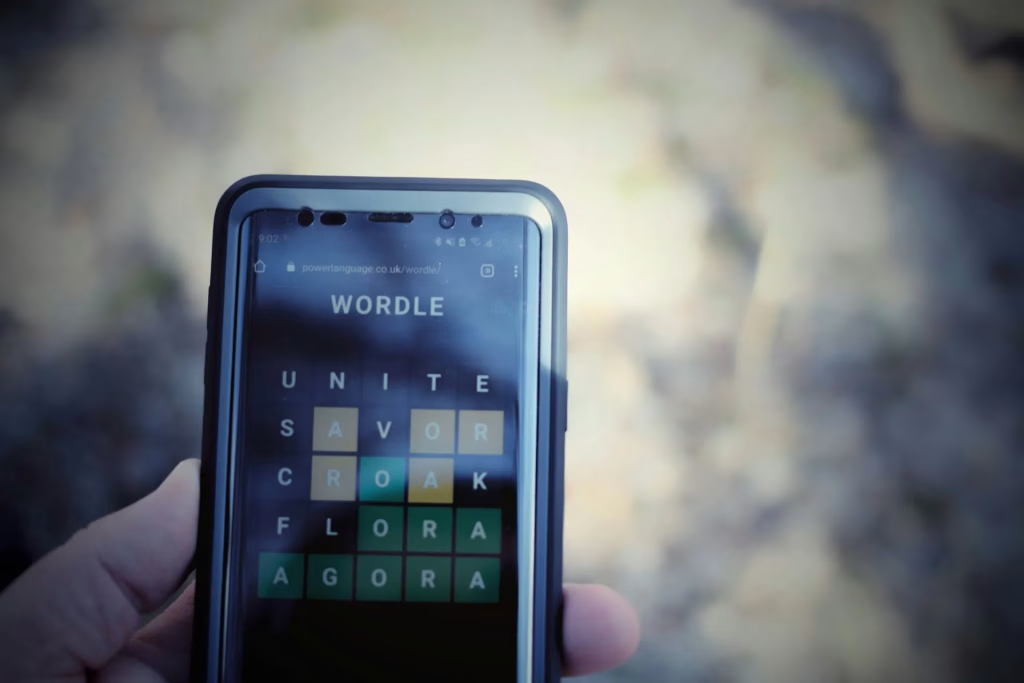
Sunday Wordle is giving vintage vibes. 3Today’s Wordle answer on Sunday, June 14, 2026, is SEPIA. But if you haven’t solved it yet, don’t scroll too fast! We’ve got layered hints below so you can crack it yourself first.5 A tricky one today, despite the answer containing four of the ten most common Wordle letters. The word evokes old photographs, faded memories, and warm brownish tones — but getting there requires navigating a vowel-heavy structure that opens up too many possibilities early on.
Let’s help you solve it before your Sunday coffee gets cold. ☕📸
Table of Contents
Wordle #1821 — Progressive Hints (Spoiler-Free First!)
Use only as many hints as you need. Stop when you’ve got it!
| Hint Level | Clue |
|---|---|
| 🟢 Hint 1 — The Vibe | Think faded photographs, antique filters, and warm brownish tones. |
| 🟡 Hint 2 — Category | Today’s word is a noun and adjective. It refers to a reddish-brown color associated with vintage photography. |
| 🟠 Hint 3 — Boundaries | 1Today’s word starts with “S”. It ends with A. |
| 🔴 Hint 4 — Structure | 1Today’s word has 3 vowels. 1There are no repeated letters. |
| ⚫ Hint 5 — Giveaway | 3A hint for today’s Wordle is: like an old photograph. Instagram’s classic warm-toned filter shares its name with this word. |
Today’s Wordle Answer — June 14, 2026
⚠️ SPOILER ALERT — Scroll below only if you’re sure!
The answer to Wordle #1821 is:
🟩 S-E-P-I-A
Why Today’s Wordle Was Deceptively Tricky
Despite being a word most people have encountered — especially through photography apps and vintage filters — SEPIA proved surprisingly difficult for many solvers. Here’s why:
| Factor | Why It’s Tricky |
|---|---|
| 3 Vowels (E, I, A) | Vowel-heavy structure creates massive possibility space early on |
| Uncommon consonant pattern | S-P pairing with three vowels is unusual for Wordle |
| Visual word, not verbal | Most people recognize SEPIA visually (Instagram filters) but don’t spell it often |
| 126 possibilities after ORATE | 5Beginning with ORATE turned both ‘A’ and ‘E’ yellow — but these are two frequent flying letters, meaning 126 possible answers remained |
| Difficulty Rating | 3.5 / 5 — Trap Factor: MEDIUM-HIGH |
The biggest trap is the massive possibility space. With three vowels and two common consonants (S and P), the word shares letter patterns with dozens of other five-letter words — SPINE, SPIRE, SPADE, SPARE, etc. — making elimination slow.
How the Experts Solved It
5 The Bot’s best Wordle start words were more effective. PALED leaves 17 answers, while SPLAT lowers that to nine. If you opened with LEAPS, only the right answer would be left over.
| Opener Strategy | Letters Revealed | Options Remaining |
|---|---|---|
| ORATE | A (yellow), E (yellow) | 126 |
| PALED | More efficient start | 17 |
| SPLAT | Strong narrowing | 9 |
| LEAPS | Perfect opener | 1 — only SEPIA left! |
The lesson? If your standard opener (CRANE, STARE, ORATE) leaves too many possibilities, pivot to a consonant-heavy second guess that tests S, P, and L simultaneously.
The Etymology Behind SEPIA
The word “sepia” comes from the Latin and Greek word “sēpía,” meaning cuttlefish. The ink secreted by cuttlefish was historically used to create a rich, reddish-brown pigment that became the standard for early photographic toning in the 19th century.
When photographers developed prints using sepia toning, the silver in the image was converted to a more stable silver sulfide compound — which not only gave photos that warm brown color but also significantly extended their lifespan. That’s why the oldest surviving photographs all have that distinctive brownish hue — it’s not fading, it’s preservation.
| SEPIA Fact | Detail |
|---|---|
| Origin | Greek “sēpía” — cuttlefish |
| Pigment | Made from cuttlefish ink |
| Photography use | 19th-century toning process |
| Purpose | Extended photo lifespan + aesthetic warmth |
| Modern use | Instagram/photo filters named after the technique |
| Color hex | #704214 — warm reddish-brown |
Best Starting Words That Would’ve Helped
Players who opened with words containing S, E, P, I, or A had a clear advantage today:
| Starter Word | Why It Helps |
|---|---|
| LEAPS | Contains all key consonants — leaves only SEPIA as answer |
| PALES | Reveals P, A, E, S — four of five correct letters |
| SPINE | Contains S, P, I, E — four matches |
| SPIRE | Similar coverage — S, P, I, E exposed |
| RAISE | Reveals A, I, S, E — strong vowel detection |
The Three-Vowel Challenge — Why Vowel-Heavy Words Are Dangerous
SEPIA joins a tricky category of three-vowel Wordle answers that consistently frustrate solvers:
| Word | Vowels | Date | Why It’s Hard |
|---|---|---|---|
| SEPIA | E, I, A | June 14, 2026 | 126 options after common openers |
| MAFIA | A, I, A | June 8, 2026 | Double-A + rare M start |
| OUIJA | O, U, I, A | Previous | Four vowels — nightmare |
| AUDIO | A, U, I, O | Previous | Four vowels — massive ambiguity |
| NAIVE | A, I, E | Previous | Three vowels + silent pattern |
Three-vowel words are paradoxically harder than low-vowel words because common openers (which are designed to find vowels) reveal TOO MANY matches — creating a massive possibility space rather than narrowing it down.
This Week’s Complete Recap — The Ultimate Streak Test
This has been one of the most challenging Wordle weeks in memory. Here’s every answer from the past 7 days:
| Day | Date | Answer | Trap | Vowels |
|---|---|---|---|---|
| Monday | June 8 | MAFIA | Double-A + rare M | 3 |
| Tuesday | June 9 | WHARF | WH- blend + F ending | 1 |
| Wednesday | June 10 | ALIGN | Silent G | 2 |
| Thursday | June 11 | TESTY | Double-T adjective | 1 |
| Friday | June 12 | BREAK | Homophone (BRAKE) | 2 |
| Saturday | June 13 | — | — | — |
| Sunday | June 14 | SEPIA | 3-vowel overload + visual word | 3 |
If your streak survived this entire week, you are genuinely in the top tier of global Wordle players. This week tested double letters, silent consonants, homophones, rare blends, and vowel-heavy structures — a gauntlet worthy of the Wordle Hall of Fame. 🏆
Recent Wordle Answers (Avoid Repeats!)
| Date | Puzzle # | Answer |
|---|---|---|
| June 14 | #1821 | SEPIA |
| June 13 | #1820 | — |
| June 12 | #1819 | BREAK |
| June 11 | #1818 | TESTY |
| June 10 | #1817 | ALIGN |
| June 9 | #1816 | WHARF |
| June 8 | #1815 | MAFIA |
1 Wordle presents a new puzzle daily, challenging players to guess a five-letter word in six attempts. Tracking past answers helps eliminate possibilities faster — Wordle almost never repeats recent answers.
What Is Wordle? A Quick Refresher
5 Wordle officially launched in October 2021, but actually started in June of that year. 5 However, it only grew in popularity towards the end of the year, then went viral in January as the world woke up to its charms. 5 In fact, it proved so successful that The New York Times bought Wordle for a seven-figure sum in early February.
For a full history of the game and its cultural impact, visit the Wordle Wikipedia page.
Pro Tips to Never Break Your Streak
- Beware of three-vowel words — When your opener reveals multiple vowels, the possibility space EXPANDS rather than narrows. Use a consonant-heavy second guess (like SPLAT or CLUMP) to compensate.
- Try LEAPS as an opener — Today it would have left only ONE possible answer. It covers L, E, A, P, S — five of the most common Wordle letters.
- Think visually — SEPIA is a word most people RECOGNIZE but rarely SPELL. If your hints point to a color or photography term, think beyond common vocabulary.
- Don’t panic at 126 options — Even after a wide-open first guess, a strategic second guess can collapse the possibility space dramatically.
- Track past answers — This week has been brutal (MAFIA, WHARF, ALIGN, TESTY, BREAK, SEPIA) — keeping a log prevents wasted guesses.
👉 Also Read: Latest Gaming News & Puzzle Guides on TechnoSports
👉 Also Read: Trending Entertainment & Gaming Stories This Week
FAQs
Q: What is today’s Wordle answer for June 14, 2026?
Q: Why was Wordle #1821 so tricky despite SEPIA being a familiar word?
5 A tricky one today, despite the answer containing four of the ten most common Wordle letters. The three-vowel structure (E, I, A) creates an enormous possibility space after common openers — 5 beginning with ORATE turned both ‘A’ and ‘E’ yellow, but still left 126 possible answers. 5 SPLAT lowers that to nine, and if you opened with LEAPS, only the right answer would be left over.